Search results
 35-946SF
Class 13 13003 BR Blue With DCC Sound Fitted
 'OO' Gauge
 Released: 01/12/25
 DCC FittedDCC Sound
 Era 7
Era 7The Class 13s were built at BR’s Darlington Works in 1965, using six standard Class 08s to create three new locomotives each comprising a Master Unit and a Slave Unit. The donor locomotives were fitted with heavy metal plates to their bufferbeams to improve adhesion, visually this resulted in the bufferbeams being both thicker and much deeper. Multi-working equipment was fitted to the two units as well, allowing both locos to be controlled from the master and enabling the cab of the slave unit to be removed. Special in-cab signalling and radio equipment was installed to allow communications with the control tower that presided over shunting operations at Tinsley.

Our Price:
£458.95
£458.95
50-000ASFXClass 66/0 66096 EWS With DCC Sound Deluxe
'OO' GaugeReleased: 01/12/25DCC FittedDCC SoundEra 9As far as locomotives go, the introduction of the Class 66 was the biggest revolution for the UK’s rail freight operations in the modern era, being born out of the Privatisation of British Rail which began in 1994. In readiness for the sale, the British Railways Board split its freight business into six companies and the Wisconsin Central Transportation Corporation emerged as the successful bidder for all but one, establishing English, Welsh & Scottish Railways (EWS) to run the operation. The sale was officially presented to the public in February 1996 and by May of the same year, EWS had ordered 250 new locomotives from General Motors’s Electro-Motive Division (EMD), to be constructed at its works in London, Ontario, Canada.

Our Price:
£314.45
£314.45
50-001Class 66/5 66515 Freightliner Green
'OO' GaugeReleased: 01/12/25DCC Ready (PluX22)Era 9As far as locomotives go, the introduction of the Class 66 was the biggest revolution for the UK’s rail freight operations in the modern era, being born out of the Privatisation of British Rail which began in 1994. In readiness for the sale, the British Railways Board split its freight business into six companies and the Wisconsin Central Transportation Corporation emerged as the successful bidder for all but one, establishing English, Welsh & Scottish Railways (EWS) to run the operation. The sale was officially presented to the public in February 1996 and by May of the same year, EWS had ordered 250 new locomotives from General Motors’s Electro-Motive Division (EMD), to be constructed at its works in London, Ontario, Canada.

Our Price:
£195.45
£195.45
50-001SFXClass 66/5 66515 Freightliner Green DCC Sound Deluxe
'OO' GaugeReleased: 01/12/25DCC FittedDCC SoundEra 9As far as locomotives go, the introduction of the Class 66 was the biggest revolution for the UK’s rail freight operations in the modern era, being born out of the Privatisation of British Rail which began in 1994. In readiness for the sale, the British Railways Board split its freight business into six companies and the Wisconsin Central Transportation Corporation emerged as the successful bidder for all but one, establishing English, Welsh & Scottish Railways (EWS) to run the operation. The sale was officially presented to the public in February 1996 and by May of the same year, EWS had ordered 250 new locomotives from General Motors’s Electro-Motive Division (EMD), to be constructed at its works in London, Ontario, Canada.

Our Price:
£314.45
£314.45
50-002Class 66/6 66606 Freightliner Green
'OO' GaugeReleased: 01/12/25DCC Ready (PluX22)Era 9As far as locomotives go, the introduction of the Class 66 was the biggest revolution for the UK’s rail freight operations in the modern era, being born out of the Privatisation of British Rail which began in 1994. In readiness for the sale, the British Railways Board split its freight business into six companies and the Wisconsin Central Transportation Corporation emerged as the successful bidder for all but one, establishing English, Welsh & Scottish Railways (EWS) to run the operation. The sale was officially presented to the public in February 1996 and by May of the same year, EWS had ordered 250 new locomotives from General Motors’s Electro-Motive Division (EMD), to be constructed at its works in London, Ontario, Canada.

Our Price:
£195.45
£195.45
50-002SFXClass 66/6 66606 Freightliner Green DCC Sound Deluxe
'OO' GaugeReleased: 01/12/25DCC FittedDCC SoundEra 9As far as locomotives go, the introduction of the Class 66 was the biggest revolution for the UK’s rail freight operations in the modern era, being born out of the Privatisation of British Rail which began in 1994. In readiness for the sale, the British Railways Board split its freight business into six companies and the Wisconsin Central Transportation Corporation emerged as the successful bidder for all but one, establishing English, Welsh & Scottish Railways (EWS) to run the operation. The sale was officially presented to the public in February 1996 and by May of the same year, EWS had ordered 250 new locomotives from General Motors’s Electro-Motive Division (EMD), to be constructed at its works in London, Ontario, Canada.

Our Price:
£314.45
£314.45
 961002
GWR IRON MINK (INTER WAR) TRIPPLE PACK
'N' GaugeReleased: 03/12/25Era 3
Our Price:
£62.95
£62.95
961003GWR IRON MINK (GW AT WAR) TRIPPLE PACK A
'N' GaugeReleased: 03/12/25Era 3
Our Price:
£62.95
£62.95
961004 GWR IRON MINK (GW AT WAR) TRIPPLE PACK B
'N' GaugeReleased: 03/12/25Era 3
Our Price:
£62.95
£62.95
961012G. FAWKES GUNPOWDER VAN
'N' GaugeReleased: 03/12/25
Our Price:
£22.45
£22.45
968001PORT OF PAR BAGNALLS TWIN PACK, LINED DARK GREEN
'OO' GaugeReleased: 03/12/25Era 5Double pack of “Judy” (Bagnall 2572) and “Alfred” (Bagnall 3058)
1960s condition
Lined dark green livery
Special Presentation Box
Illustrated booklet describing the history of the locomotives
Postcard print of exclusive Jonathan Clay painting.
* NOTE – THESE LOCO’S REQUIRE AN E24 DCC DECODER

Our Price:
£237.95
£237.95
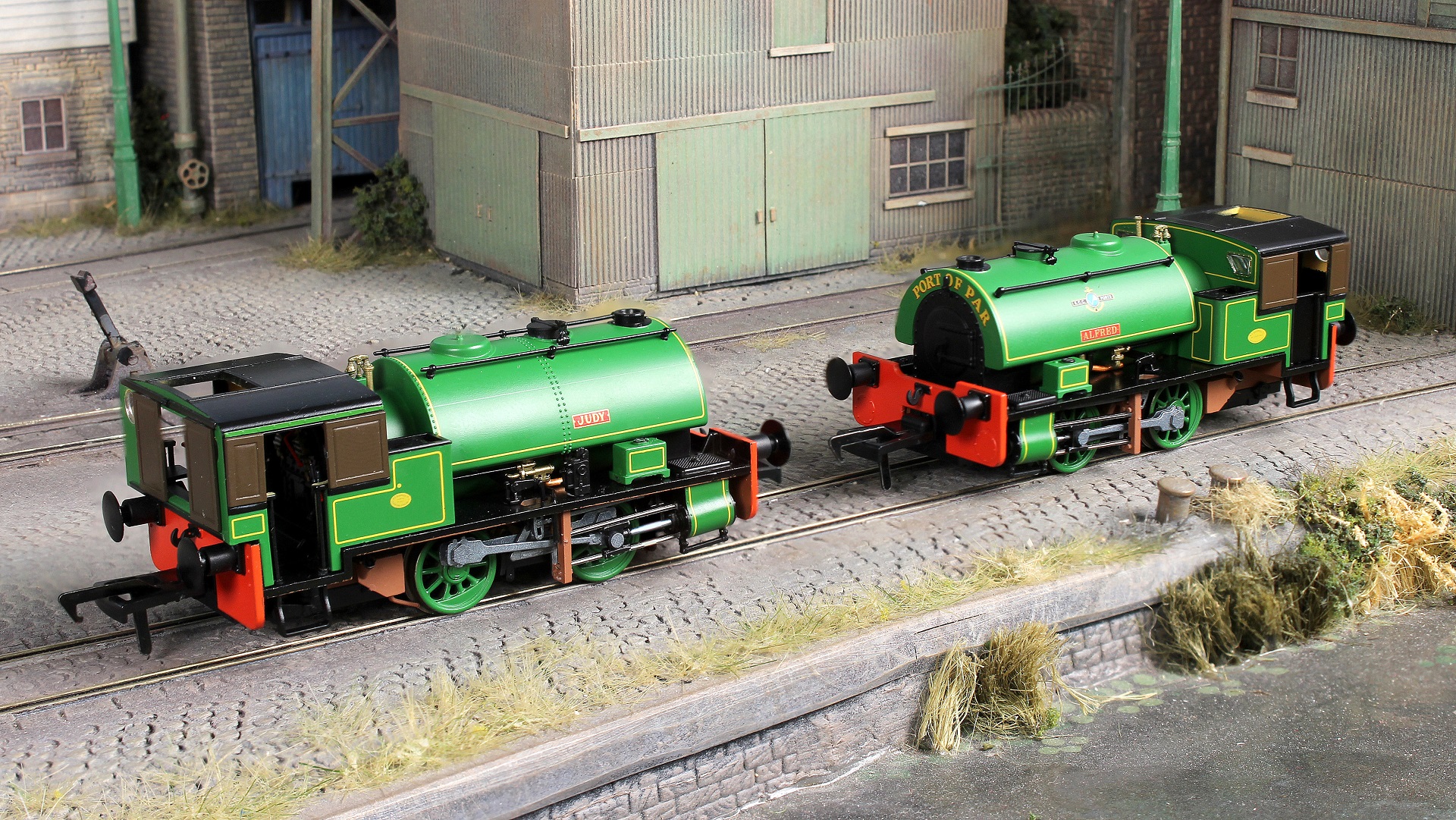
968002PORT OF PAR BAGNALLS TWIN PACK, LINED LIGHT GREEN (AS PRESERVED)
'OO' GaugeReleased: 03/12/25Era 11Double pack of “Judy” (Bagnall 2572) and “Alfred” (Bagnall 3058)
2010s condition
Lined light green livery
Special Presentation Box
Illustrated booklet describing the history of the locomotives
Postcard print of exclusive Jonathan Clay painting.
*NOTE – THESE LOCO’S REQUIRE AN E24 DCC DECODER
Our Price:
£237.95
£237.95
968502PORT OF PAR BAGNALLS TWIN PACK, LINED LIGHT GREEN (AS PRESERVED) DCC SOUND FITTED
'OO' GaugeReleased: 03/12/25DCC FittedDCC SoundEra 11Double pack of “Judy” (Bagnall 2572) and “Alfred” (Bagnall 3058)
2010s condition
Lined light green livery
Special Presentation Box
Illustrated booklet describing the history of the locomotives
Postcard print of exclusive Jonathan Clay painting

Our Price:
£424.95
£424.95
35-945Class 13 D4502 BR Green (Wasp Stripes)
'OO' GaugeReleased: 09/12/25DCC Ready (PluX22)Era 6Although diesel shunters had been trialled by the ‘Big Four’ railway companies as early as the 1930s, it was not until after Nationalisation in 1948 that their use became widespread, culminating in the creation of the British Railways (BR) 350hp diesel electric shunter – or Class 08. Eventually 996 locomotives were built, making the Class 08 the most numerous of all British locomotive classes.
The 08s proved to be strong and versatile machines, capable of most shunting tasks, but there were some unique scenarios where they were not quite up to the job. One such scenario was at Tinsley Marshalling Yard, to the northeast of Sheffield; an enormous freight marshalling yard which opened in 1965 and was essentially a distribution hub where goods trains would arrive, be broken down, and were then reformed for onwards travel to other destinations. To aid the forming of new trains the yard employed hump shunting which allowed wagons to roll into the siding where their train was being assembled, however, to move these trains and propel the wagons up the hump for gravity to take effect, a new locomotive was required.
The solution was the Class 13. Formed of two modified Class 08s, the 13s had a greater tractive effort than any standard locomotive in BR’s fleet at the time, and by using two locomotives coupled together rather than one long-framed bogie locomotive, the risk of grounding on the hump was avoided.

Our Price:
£339.95
£339.95
35-945SFClass 13 D4502 BR Green (Wasp Stripes) With DCC Sound Fitted
'OO' GaugeReleased: 09/12/25DCC FittedDCC SoundEra 6Although diesel shunters had been trialled by the ‘Big Four’ railway companies as early as the 1930s, it was not until after Nationalisation in 1948 that their use became widespread, culminating in the creation of the British Railways (BR) 350hp diesel electric shunter – or Class 08. Eventually 996 locomotives were built, making the Class 08 the most numerous of all British locomotive classes.
The 08s proved to be strong and versatile machines, capable of most shunting tasks, but there were some unique scenarios where they were not quite up to the job. One such scenario was at Tinsley Marshalling Yard, to the northeast of Sheffield; an enormous freight marshalling yard which opened in 1965 and was essentially a distribution hub where goods trains would arrive, be broken down, and were then reformed for onwards travel to other destinations. To aid the forming of new trains the yard employed hump shunting which allowed wagons to roll into the siding where their train was being assembled, however, to move these trains and propel the wagons up the hump for gravity to take effect, a new locomotive was required.
The solution was the Class 13. Formed of two modified Class 08s, the 13s had a greater tractive effort than any standard locomotive in BR’s fleet at the time, and by using two locomotives coupled together rather than one long-framed bogie locomotive, the risk of grounding on the hump was avoided.

Our Price:
£458.95
£458.95
35-777Class 69 69002 'Bob Tiller CM&EE' BR Blue (Large Logo) (GBRf)
'OO' GaugeReleased: 09/12/25DCC Ready (PluX22)Era 11The Class 69 Diesel Locomotive was conceived by rail freight operator GB Railfreight (GBRf) to meet their growing locomotive needs. With a requirement for locomotives similar in performance to their fleet of Class 66s, but being unable to purchase new Class 66s, GBRf turned to redundant Class 56s which could be converted into new locos with similar capabilities. As part of the conversion new equipment and systems were installed, including EMD 710 diesel engines, the same as those used in Class 66s. The pool of Class 56s to be converted included examples built at BREL Crewe, BREL Doncaster and Electroputere in Romania, with the conversion work undertaken in Stoke-On-Trent by the American company Progress Rail.
GBRf formally announced the project in Spring 2019 and the first locomotive, No. 69001, commenced running trials at the Severn Valley Railway in February 2021. The type received approval by the Office of Rail and Road in May 2021, allowing the new locomotives to be pressed into service.

Our Price:
£212.45
£212.45
35-780Class 69 69005 'Eastleigh' BR Green (Late Crest) (GBRf)
'OO' GaugeReleased: 09/12/25DCC Ready (PluX22)Era 11The Class 69 Diesel Locomotive was conceived by rail freight operator GB Railfreight (GBRf) to meet their growing locomotive needs. With a requirement for locomotives similar in performance to their fleet of Class 66s, but being unable to purchase new Class 66s, GBRf turned to redundant Class 56s which could be converted into new locos with similar capabilities. As part of the conversion new equipment and systems were installed, including EMD 710 diesel engines, the same as those used in Class 66s. The pool of Class 56s to be converted included examples built at BREL Crewe, BREL Doncaster and Electroputere in Romania, with the conversion work undertaken in Stoke-On-Trent by the American company Progress Rail.
GBRf formally announced the project in Spring 2019 and the first locomotive, No. 69001, commenced running trials at the Severn Valley Railway in February 2021. The type received approval by the Office of Rail and Road in May 2021, allowing the new locomotives to be pressed into service.

Our Price:
£212.45
£212.45
35-780SFXClass 69 69005 'Eastleigh' BR Green (Late Crest) (GBRf) With DCC Sound Deluxe
'OO' GaugeReleased: 09/12/25DCC FittedDCC SoundEra 11The Class 69 Diesel Locomotive was conceived by rail freight operator GB Railfreight (GBRf) to meet their growing locomotive needs. With a requirement for locomotives similar in performance to their fleet of Class 66s, but being unable to purchase new Class 66s, GBRf turned to redundant Class 56s which could be converted into new locos with similar capabilities. As part of the conversion new equipment and systems were installed, including EMD 710 diesel engines, the same as those used in Class 66s. The pool of Class 56s to be converted included examples built at BREL Crewe, BREL Doncaster and Electroputere in Romania, with the conversion work undertaken in Stoke-On-Trent by the American company Progress Rail.
GBRf formally announced the project in Spring 2019 and the first locomotive, No. 69001, commenced running trials at the Severn Valley Railway in February 2021. The type received approval by the Office of Rail and Road in May 2021, allowing the new locomotives to be pressed into service.

Our Price:
£331.45
£331.45
 4P-004-001
GWR AUTOCOACH '37' GWR LINED CRIMSON LAKE
'OO' GaugeReleased: 05/12/25DCC Ready (Next18)Era 2
Our Price:
£74.39
£74.39
4P-004-002GWR AUTOCOACH '40' GWR LINED CHOCOLATE & CREAM
'OO' GaugeReleased: 05/12/25DCC Ready (Next18)Era 3
Our Price:
£74.39
£74.39